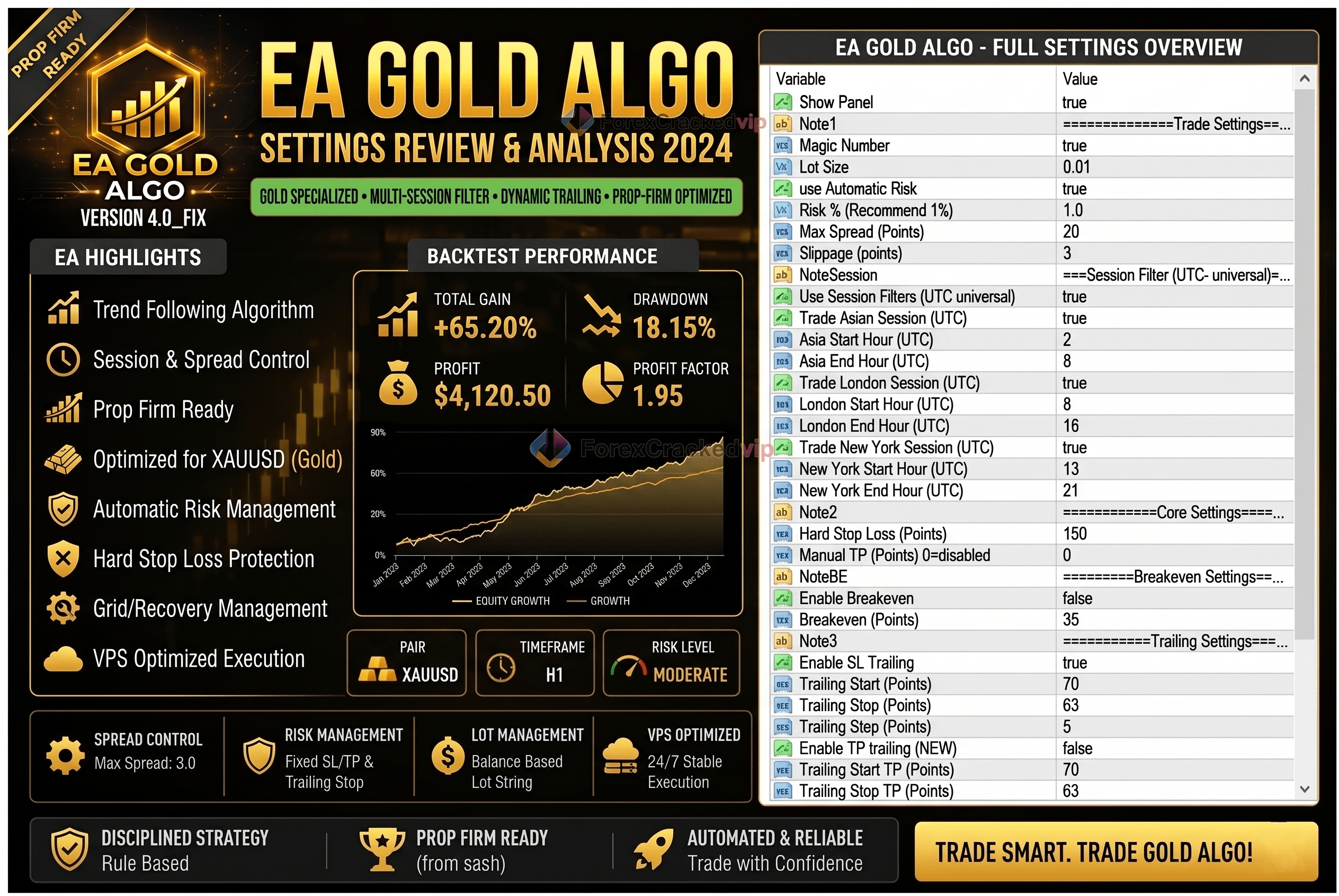
Forex traders focus on automated systems that behave consistently across different market conditions. EA settings reveal execution logic, risk exposure, and trade management style. Many systems look similar on the surface, yet configuration structure exposes how trades get opened, managed, and closed.
EA Gold Algo MT4 shows a setup built around session-based execution, controlled risk exposure, and trailing-driven exits. The configuration leans toward structured trade management rather than aggressive scaling logic. Spread control, session filters, and trailing parameters form the core decision framework.
This review breaks down each visible setting group, explains trading behavior behind them, and highlights practical expectations in live market conditions. The goal is clear understanding of how this EA behaves during volatility, trends, and ranging conditions.
➡️ Gecko EA MT4 Download: Available on Unlimited Download
➡️ Telegram Support: Join for updates, announcements, and support
EA Gold Algo MT4 Setting Panel Overview
The EA Gold Algo MT4 includes a structured panel covering execution control, risk parameters, session filters, and trade management logic. Core components include automatic risk sizing, fixed lot control, spread limitation, slippage handling, and multi-session trading windows. Trade management includes trailing stop logic and optional breakeven control. Execution filters rely on session timing across Asian, London, and New York markets. These layers define how trades enter and exit under different volatility environments.
Core Strategy Settings
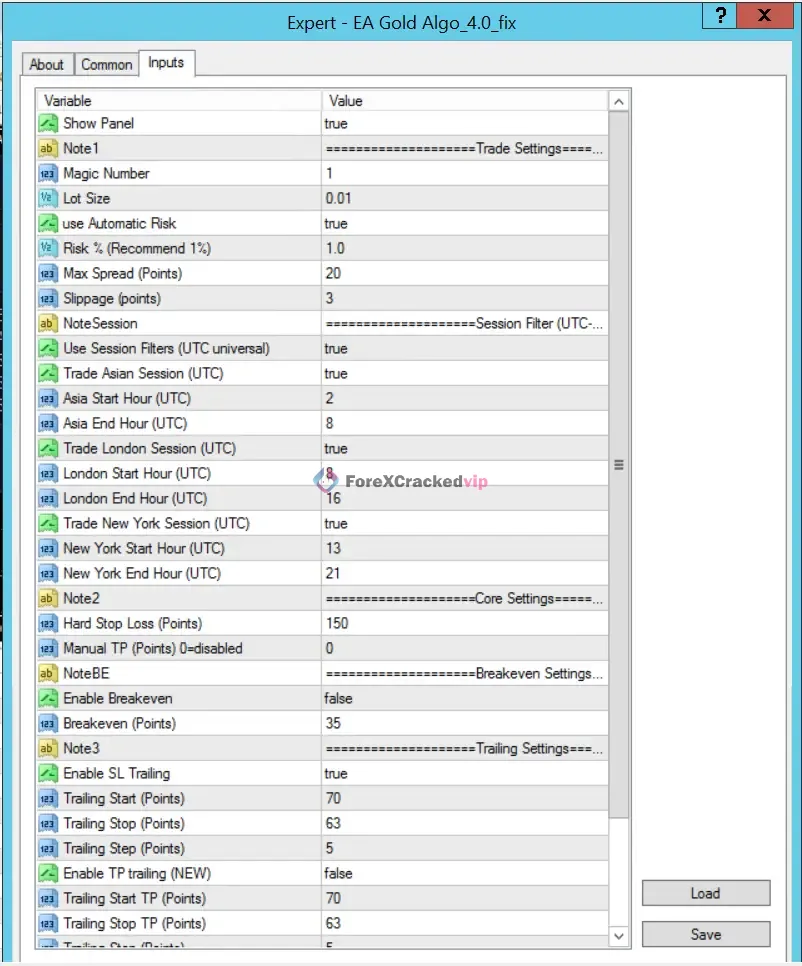
The magic number separates EA trades from manual orders and other systems running on the same account. This structure supports portfolio separation and cleaner trade tracking. No visible indicator logic or entry filters appear here, which indicates execution depends more on session timing and internal strategy rules rather than complex multi-indicator confirmation layers.
- Magic Number + 1
- Show Panel + true
This structure often aligns with session-driven entry logic. Trades tend to appear during specific liquidity windows rather than continuous execution. In trending conditions, trade frequency aligns with session strength. In ranging markets, fewer entries appear due to reduced momentum triggers. Without heavy filtering layers, exposure depends on session volatility, which increases sensitivity during news spikes or sudden spread expansion.
Risk Management & Lot Size Settings
Risk structure relies on percentage-based calculation with fallback fixed lot input. This hybrid design supports consistent exposure scaling across account sizes. Spread limitation blocks trade entries during high-cost conditions. Slippage control reduces execution deviation during fast markets. Risk level sits in conservative range, targeting small exposure per trade.
- Lot Size + 0.01
- Automatic Risk + true
- Risk % + 1.0
- Max Spread + 20
- Slippage + 3
Low risk percentage systems reduce account pressure during volatility spikes. However, exposure still increases during rapid consecutive signals. In strong trends, position stacking remains controlled. In ranging markets, frequent small losses remain limited but may accumulate slowly. Spread filters protect during illiquid sessions, yet sharp news events still create execution gaps. This type of structure favors steady growth behavior rather than fast capital expansion.
Session Filter / Session Control Settings
Session-based logic controls trade activity across global liquidity cycles. Asian session allows low volatility participation. London session introduces higher momentum setups. New York session supports continuation or reversal behavior depending on overlap conditions. Full-day coverage indicates multi-window trading rather than single-market focus.
Session filters reduce noise during low liquidity periods. Asian trades often show slower movement with smaller ranges. London sessions increase breakout probability. New York overlap increases volatility spikes and false breakouts. Without strict direction filters, execution during overlapping sessions may increase trade density. This structure typically produces uneven trade distribution across the day, with higher activity during London and New York phases.
Core Stop Loss & Take Profit Settings
Stop loss is fixed at a defined distance, providing structural risk containment per trade. Take profit remains disabled, shifting exit logic toward trailing management. This setup indicates dynamic exit preference instead of fixed reward targets.
Fixed stop loss with dynamic exit logic often supports trend-following behavior. During strong trends, trades remain open longer through trailing activation. In sideways markets, stop loss hits become more frequent due to lack of directional extension. Absence of fixed take profit increases dependence on trailing quality. Poor volatility conditions may lead to early exit cycles with limited net gain.
Position Management & Trailing Settings
Trailing stop logic activates after price reaches defined profit distance. Step-based movement locks profits gradually. Stop loss adjustment follows price direction, reducing open risk over time. TP trailing remains inactive, keeping focus on stop-based exit progression.
Trailing systems perform better in sustained trends. Profit protection increases as price extends. In choppy markets, frequent retracements trigger premature exits. Step distance affects sensitivity, smaller steps tighten exits while larger steps allow wider swings. High volatility pairs may activate trailing too early, leading to reduced final profit capture. This structure favors trend continuation rather than short scalp behavior.
Grid / Recovery Settings
No scaling or averaging logic appears in the EA Gold Algo MT4 settings. Trade structure remains isolated per entry without visible martingale or layered recovery system. This reduces compounded exposure behavior.
Absence of grid logic reduces catastrophic drawdown risk linked to averaging systems. Losses remain trade-based rather than basket-based. However, recovery after losing streak depends fully on future signal quality rather than structured recovery cycles. In long ranging conditions, performance stability depends on entry precision rather than averaging support.
VPS & Execution Settings
Execution sensitivity remains moderate. Spread filter protects entry timing. Slippage control reduces order deviation during fast execution environments. These parameters indicate reliance on stable broker execution conditions.
- Slippage + 3
- Max Spread + 20
VPS usage improves execution stability during high-volatility sessions. Latency delays increase slippage risk, especially during London and New York overlaps. ECN execution environments reduce spread distortion. Poor execution conditions increase stop loss hits due to entry mismatch and delayed order fills.
Recommended Timeframe & Currency Pair Settings
EA Gold Algo MT4 structure remains flexible across instruments. Performance depends on volatility behavior rather than fixed timeframe constraints.
Gold-focused strategies typically align with M15 to H1 behavior. Lower timeframes increase noise and false triggers. Higher timeframes reduce trade frequency but improve trend alignment. Gold reacts strongly to macroeconomic volatility, which increases trailing dependency and stop loss sensitivity.
EA Gold Algo MT4 Drawdown Risk Analysis
TheEA shows moderate risk exposure due to fixed stop loss and absence of grid recovery logic. Drawdown appears trade-based rather than compounded.
Losing streaks depend on consecutive false entries during ranging conditions. Volatility spikes increase stop loss hits during news periods. Risk per trade remains controlled at 1 percent, limiting single-trade damage. However, multiple consecutive losses still affect equity curve stability.
Worst-case scenarios appear during sideways markets with high spread expansion. Trailing logic reduces profit retention during unstable trends. Long flat markets produce slow recovery cycles without recovery scaling mechanisms.
VPS & Execution Requirements
Stable VPS improves execution timing during session transitions. Low latency reduces slippage impact during London and New York overlaps. High-speed broker execution reduces stop loss deviation risk. Slow execution environments increase entry delay and reduce trailing effectiveness.
Recommended Broker Conditions
ECN or STP accounts support better spread control. Low spread environments improve entry precision. High leverage supports margin flexibility but increases exposure risk during multiple trades. Slippage sensitive brokers reduce trailing inefficiency. Fixed spread accounts reduce performance stability for session-based strategies.
EA Gold Algo MT4 Trading Summary
EA Gold Algo MT4 follows session-based execution with trailing-driven exits and controlled risk exposure. Strategy behavior aligns with trend continuation during high liquidity sessions. Risk level remains moderate due to fixed stop loss and lack of grid recovery logic. Performance depends heavily on execution quality and volatility structure. Long-term results vary based on market conditions rather than fixed outcome patterns.
Frequently Asked Questions (FAQ)
What currency pair works best
Gold pairs such as XAUUSD show strongest alignment due to volatility structure.
What timeframe suits this EA
M15 to H1 range supports balanced signal quality and reduced noise.
Does this EA require VPS
VPS improves execution during London and New York sessions.
Grid trading behavior present
No grid or recovery logic appears in current configuration.
Beginner suitability level
Moderate level due to trailing and session-based structure.
Leverage requirement
Medium leverage supports margin stability during multiple trades.
Account size recommendation
Small accounts require strict risk monitoring due to fixed stop loss distance.
Gold and crypto compatibility
Gold alignment appears stronger than crypto due to volatility consistency.