How to Manage Risk in Forex Trading in 2026 – A Practical Guide for Beginners and Serious Traders
If you want to stay in the market long enough to become profitable, risk management in forex trading matters more than finding the “perfect” entry. In 2026, the traders who last are not always the ones with the best signals, the fastest indicators, or the most aggressive strategies. They are the ones who know how to protect capital, control losses, and trade with a plan. This guide explains how to manage risk in forex trading 2026 in a clear, practical way, starting with the basics and moving into deeper strategies that serious traders use to survive and grow.
➡️ Telegram Support: Join for updates, announcements, and support
Why Risk Management Matters More Than Strategy
Many new traders enter forex with the same belief: if they can just find the right strategy, profits will follow. That idea sounds logical, but it is incomplete. A strategy tells you when to enter and exit. Risk management decides how much damage a bad trade can do.
That difference is everything.
You can have a strategy with a decent win rate and still destroy your account if your position size is too large, your stop loss is random, or you keep increasing risk after losses. On the other hand, even a simple strategy can perform surprisingly well when paired with disciplined money management.
In real trading, losses are not optional. They are part of the business. What separates consistent traders from frustrated ones is not whether they lose. It is how they lose.
A trader with poor risk control may lose 20% of an account in one bad day. A trader with sound discipline may lose 2% and still have a clear head, enough capital, and enough confidence to keep going. Over time, that difference becomes massive.
Best Forex EAs to Consider if Risk Management Matters in 2026
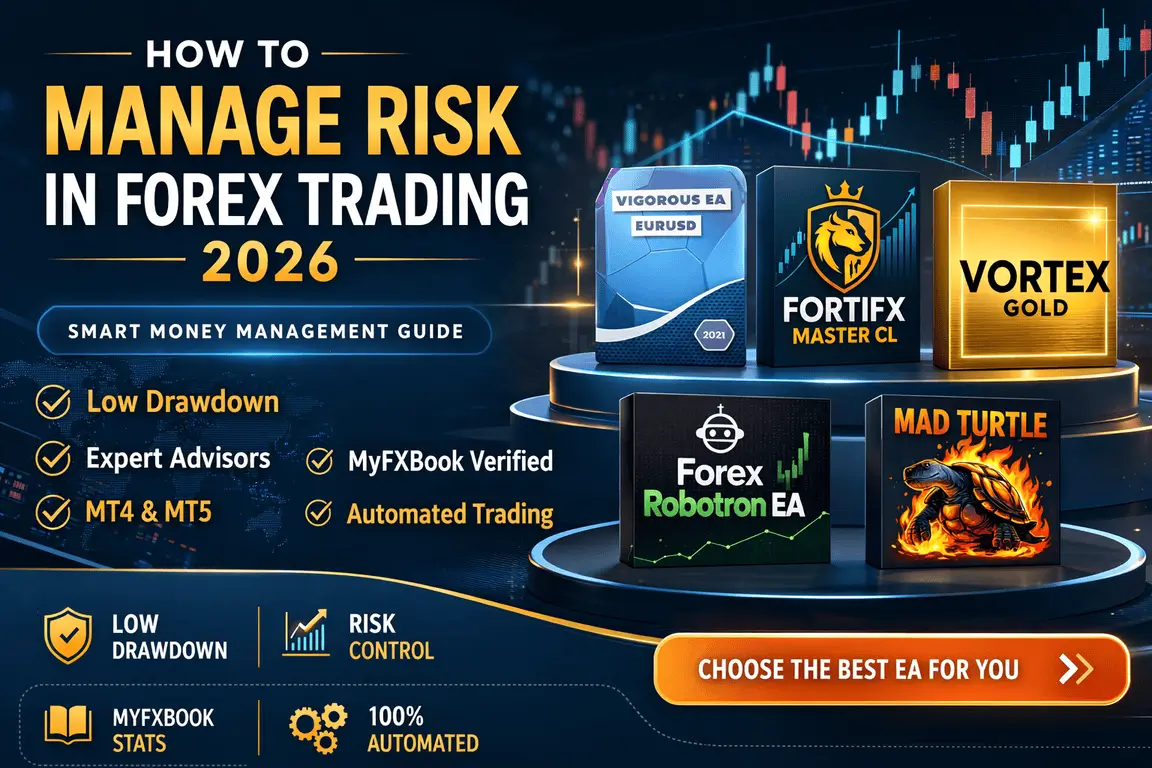
Reading about risk control is important, but choosing the right Expert Advisor can make that process much easier. If you want an MT4 or MT5 trading system that already emphasizes risk management, controlled execution, MyFXBook tracking, and lower drawdown behavior, these tools are worth looking at.
Below is a practical breakdown of each EA based on the product details available, including platform, market focus, risk profile, and how well each one fits a trader who cares about account protection first. The risk management score is an editorial score based on the risk-related details shown on the product page, especially factors like drawdown, safety logic, money management, account setup, and overall risk structure.
Vigorous EA MT4
📌 Risk Management Score: 5.5/10 📌
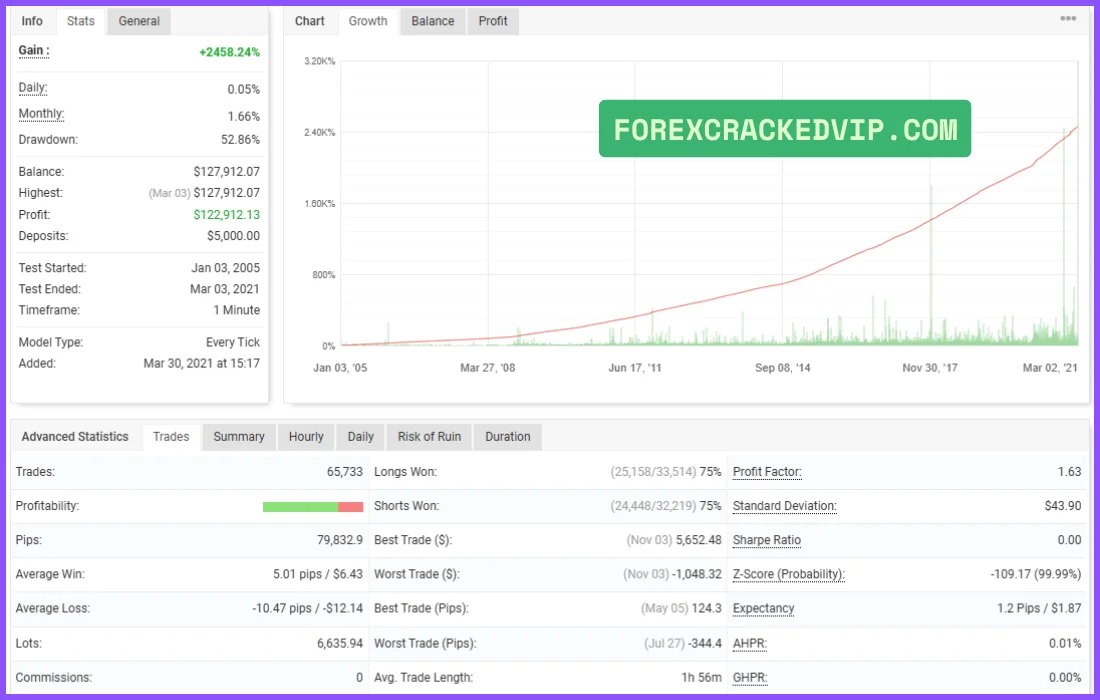
Vigorous EA MT4 is a scalping Expert Advisor built for EUR/USD on MT4, with the product page highlighting 16+ years of trading history, advanced money management, a smart recovery system, and verified MyFXBook stats. The page also lists a maximum drawdown of 52.86%, which is much higher than a true Low Drawdown setup, even though it promotes strong automation and long-term profitability.
>>== Download Vigorous EA MT4 ==<<
Why it fits this blog:
-
Good for traders who want a fully automated MT4 Expert Advisor with customizable risk and trade controls.
-
Less attractive for traders whose main priority is strict drawdown control, because the published MyFXBook figure shows a relatively aggressive risk profile.
Why someone may still buy it:
If your goal is to run a high-activity MT4 scalping EA on EUR/USD and you are comfortable using conservative lot sizing, Vigorous EA can still be attractive because it offers automation, flexibility, and proven long-term tracking. But from a pure forex risk management perspective, this one should be treated as a higher-risk tool and used with tighter personal exposure rules.
FortiFx Master CL MT4
📌 Risk Management Score: 8.7/10 📌
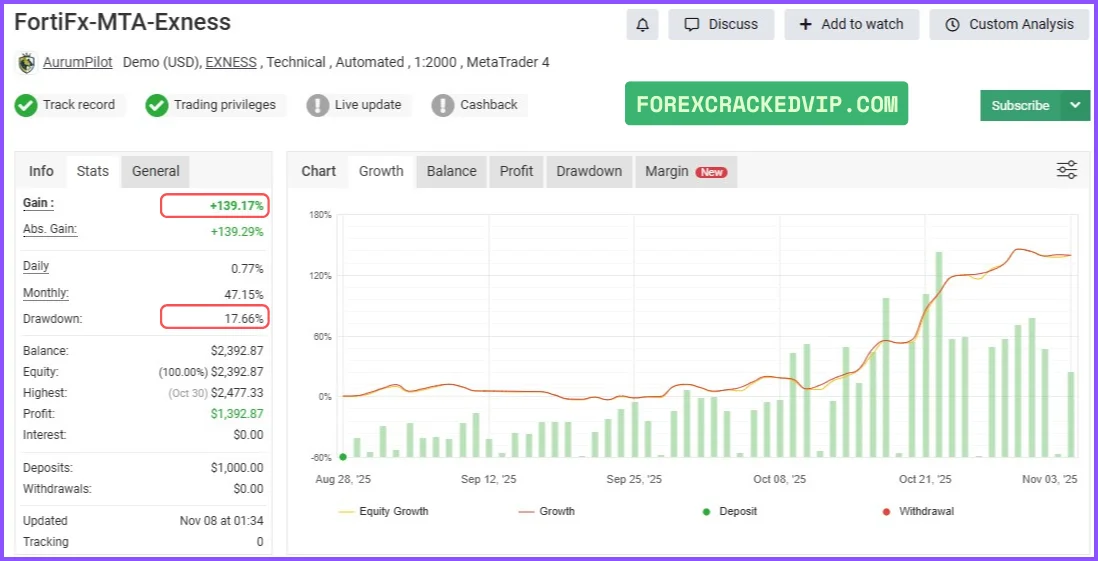
FortiFx Master CL MT4 is one of the cleanest matches for a risk-focused article like this. It is a Gold Expert Advisor for MT4 designed specifically for XAUUSD on M5, and the page repeatedly emphasizes Low Drawdown, controlled risk, selective entry logic, tight risk filters, and safe money management. It also shows a MyFXBook result with +139.17% gain and 17.66% drawdown, which places it in a much more appealing range for traders who want a better balance between growth and protection.
>>== Download FortiFx Master CL MT4 ==<<
Why it fits this blog:
-
It is clearly built around controlled risk, not just raw profit claims.
-
The published drawdown is far more reasonable than many aggressive gold robots.
-
It is beginner-friendly but still relevant for experienced traders who want a specialized MT4 Gold EA.
Why someone should buy it:
If a reader finishes this blog thinking, “I want an MT4 Expert Advisor that respects risk management better than most gold bots,” FortiFx Master CL MT4 is one of the strongest options here. The combination of MyFXBook tracking, Low Drawdown positioning, and a gold-specific design makes it easier to trust than a generic robot trying to trade everything.
Vortex Gold EA
📌 Risk Management Score: 8.5/10 📌
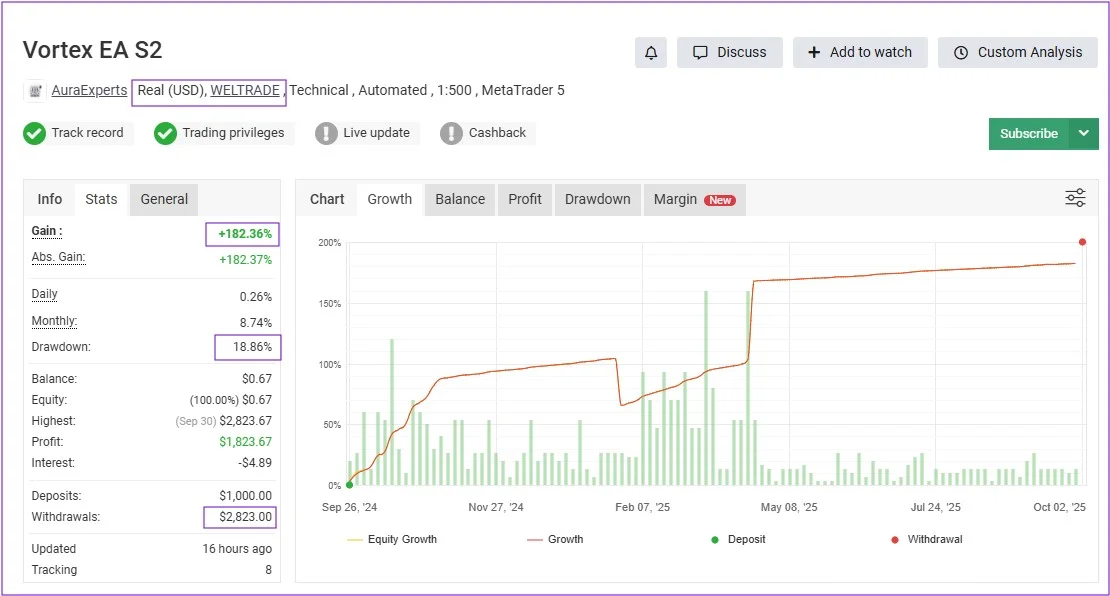
Vortex Gold EA is another strong candidate for traders who want a Gold Expert Advisor with a more balanced risk profile. The page describes it as an MT4 Forex robot for gold that focuses on smart entry algorithms, protective money management, verified MyFXBook performance, and controlled drawdown. Its published metrics show +182.36% total gain with 18.86% drawdown, which is a healthy combination for traders who care about both growth and stability.
>>== Download Vortex Gold EA==<<
Why it fits this blog:
-
The drawdown shown is moderate enough to support a real Low Drawdown marketing angle compared with many aggressive EAs.
-
It promotes protective money management rather than relying only on backtest hype.
-
It suits traders who want a focused MT4 Gold EA with MyFXBook visibility.
Why someone should buy it:
If the reader wants an MT4 Expert Advisor for gold that appears more measured than many high-risk bots, Vortex Gold EA is easy to position as a smart buy. It looks especially attractive for traders who want verified MyFXBook, a specialized XAUUSD system, and a realistic balance between return and account safety.
Forex Robotron EA MT4
📌 Risk Management Score: 7.8/10 📌
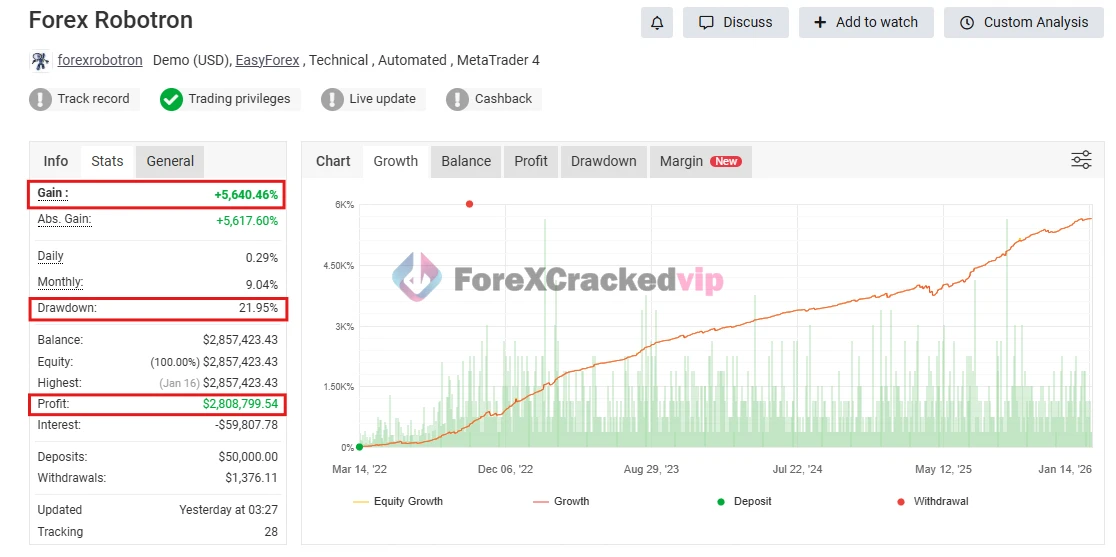
Forex Robotron EA MT4 stands out because of its long development background, multi-pair focus, and several published MyFXBook results. The product page describes it as a fully automated MT4 Expert Advisor using adaptive market logic and strict risk management, with one verified account showing 21.95% drawdown, another showing 43.86%, and another showing 17.42%. That tells an important story: the EA has real performance depth, but risk outcomes can vary significantly depending on settings, account conditions, or deployment style.
>>== Download Forex Robotron EA MT4==<<
Why it fits this blog:
-
It has stronger credibility than many robots because multiple MyFXBook results are presented.
-
One result shows a respectable 17.42% drawdown, but another reaches 43.86%, so this is not the most conservative option in the list.
-
It may suit traders who want a more established automated MT4 system and are willing to manage settings carefully.
Why someone should buy it:
For buyers who want a recognized Expert Advisor with strong historical numbers and visible MyFXBook proof, Forex Robotron EA MT4 has strong sales appeal. The best way to position it in a risk-management article is this: it can be a solid buy for traders who want performance and automation, but it should be paired with disciplined lot sizing and realistic expectations around drawdown.
Mad Turtle EA MT5
📌 Risk Management Score: 9.4/10 📌
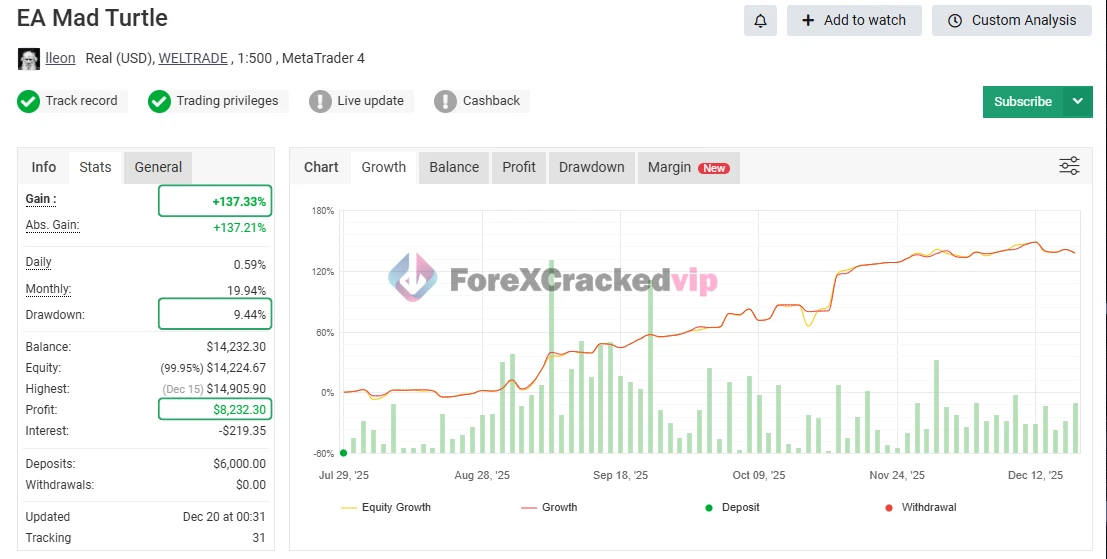
If your blog wants one tool that feels especially aligned with modern risk management in forex trading 2026, Mad Turtle EA MT5 is one of the strongest choices. It is a machine-learning Expert Advisor for MT5 that emphasizes overfit control, independent validation, transparent probability logic, fixed or auto lot sizing, adjustable stop loss and take profit coefficients, and a structure with no martingale and no grid. The published MyFXBook result shows +137.33% gain with just 9.44% drawdown, which is the most impressive risk-adjusted profile among the tools listed here.
>>== Download Mad Turtle EA MT5 ==<<
Why it fits this blog:
-
The page directly highlights flexible risk management tools.
-
It avoids two major danger zones for many EAs: martingale and grid.
-
The published MyFXBook drawdown of 9.44% is highly attractive for traders searching for a true Low Drawdown MT5 Expert Advisor.
-
Its H1 structure and single-order execution style suggest a calmer risk profile than ultra-fast scalpers.
Why someone should buy it:
If the reader wants an MT5 Expert Advisor that looks more serious, modern, and risk-aware than the average robot, Mad Turtle EA MT5 is very easy to recommend. The mix of MyFXBook, Low Drawdown, machine-learning logic, fixed or automatic lot control, and no martingale/grid structure makes it the most convincing “risk-first” buy in this list.
What Risk Management in Forex Actually Means
At its core, forex risk management means controlling downside before you think about upside.
It includes:
-
deciding how much of your account to risk on each trade
-
using a logical stop loss
-
calculating position size correctly
-
limiting daily and weekly drawdown
-
avoiding emotional revenge trades
-
adapting exposure to market conditions
-
protecting profits during good periods
-
surviving losing streaks without account damage
This is not just a technical process. It is also psychological. Good risk management reduces panic, greed, hesitation, and overconfidence. When you know one trade cannot seriously hurt you, it becomes easier to follow your system with discipline.
The First Rule – Protect Capital Before Chasing Profit
The most important mindset shift in forex is simple:
Your first job is not to make money. Your first job is to avoid losing too much money.
That may sound negative, but it is actually the foundation of long-term growth. Trading accounts do not grow because of one big win. They grow because capital stays alive long enough for a real edge to play out across many trades.
Think of your capital as inventory in a business. If you waste the inventory, the business stops. In trading, once capital is damaged badly, recovery becomes much harder.
For example:
-
Lose 10%, and you need about 11.1% to recover
-
Lose 20%, and you need 25% to recover
-
Lose 30%, and you need about 42.9% to recover
-
Lose 50%, and you need 100% to get back to breakeven
This is why drawdown control is so important. Large losses create a steep recovery curve. Good risk management keeps that curve manageable.
The Best Risk Per Trade for Forex Traders
One of the most common questions is: how much should you risk per trade?
For most traders, especially beginners, a smart range is:
-
0.25% to 0.5% per trade for cautious trading
-
1% per trade for standard controlled risk
-
Above 2% per trade is usually too aggressive for most people
If your account is $1,000 and you risk 1% per trade, your maximum loss on a trade is $10.
If your account is $5,000 and you risk 1% per trade, your maximum loss is $50.
This approach sounds small to many beginners because social media has trained people to expect fast growth. But that expectation is exactly what pushes traders into oversized positions, emotional decisions, and account blowups.
Small risk may feel slow, but it gives you something more valuable than excitement: survival.
Why Fixed Percentage Risk Works Better Than Random Lot Sizes
A lot of traders still trade with random fixed lot sizes. For example, they always use 0.10 lots, no matter the setup, stop loss distance, or account condition. That is dangerous because the actual risk changes from trade to trade.
A better method is fixed percentage risk.
With this model:
-
your risk stays consistent
-
your lot size adjusts based on stop loss distance
-
your exposure scales with account size
-
drawdowns become easier to manage
This is one of the most practical forms of forex money management because it creates structure. It also helps you think like a professional instead of gambling based on feeling.
Position Sizing – The Skill Most Traders Ignore
Forex position sizing is where risk management becomes real. You can say you want to risk 1%, but unless you calculate the correct lot size, that number means nothing.
Position size depends on three things:
-
Account size
-
Risk percentage
-
Stop loss distance
For example, if:
-
your account is $2,000
-
you risk 1%
-
your stop loss is 50 pips
Then your maximum risk is $20. Your position size should be set so that a 50-pip loss equals $20.
This is why professional traders do not choose lot size first. They choose:
-
trade idea
-
invalidation point
-
stop loss distance
-
acceptable risk
-
then correct position size
That order matters.
If you choose lot size first because you want bigger profit, you are building the trade around emotion. If you choose risk first, you are building it around logic.
Stop Loss Is Not Optional
A trader who says they trade without a stop loss is usually doing one of two things:
-
hiding risk
-
delaying a loss until it becomes much worse
A stop loss is not there to annoy you. It is there to define the exact point where your trade idea is wrong. Without that point, there is no real control.
In 2026, forex markets still move fast around macro events, session opens, data releases, and unexpected sentiment shifts. That means even a trade that “looks safe” can move sharply against you. A stop loss turns unknown downside into known downside.
That alone makes it one of the most powerful tools in any trading plan.
Where to Place a Stop Loss Properly
A stop loss should not be based on the amount of money you hope not to lose. It should be based on market structure.
Good stop loss locations often sit:
-
below a valid support zone on a long trade
-
above a valid resistance zone on a short trade
-
beyond a swing high or swing low
-
outside the normal noise of the setup
-
beyond the point where the trade idea no longer makes sense
Bad stop losses are often:
-
too tight just to increase lot size
-
placed at obvious levels where everyone is clustered
-
chosen emotionally after entry
-
moved farther away to avoid taking a loss
A stop loss should be logical first. Position size should then be adjusted to fit the risk.
Risk-to-Reward Ratio: Useful, But Not Magic
You will often hear traders talk about risk-to-reward ratios like 1:2, 1:3, or more. This means if you risk 1 unit, you aim to make 2 or 3 units.
This concept matters, but it must be used correctly.
A strong risk-to-reward ratio can improve long-term performance because it allows you to be profitable even with a modest win rate. For example, if you risk 1 and make 2, you do not need to win every trade to stay positive.
But here is the important part:
A good risk-to-reward ratio is only useful if the target is realistic.
Some traders force wide profit targets just to make the numbers look good. That may improve the spreadsheet, but it can lower actual performance if price rarely reaches those targets.
The better approach is to balance:
-
setup quality
-
market conditions
-
historical behavior
-
realistic target placement
-
overall expectancy
In other words, do not chase a beautiful ratio on paper. Build a plan that works in real market conditions.
The Danger of Overleveraging in Forex
Leverage is one of the reasons forex looks attractive. It allows traders to control larger positions with smaller capital. Used carefully, leverage is a tool. Used carelessly, it becomes a fast way to destroy an account.
The problem is not leverage by itself. The problem is overexposure.
A trader may think, “My broker gives me high leverage, so I should use it.” That is the wrong mindset. The existence of available leverage does not mean you should trade near the limit.
Good traders use leverage conservatively because they understand that volatility, slippage, and emotional mistakes can turn aggressive exposure into rapid losses.
In practical terms, if your position is so large that a normal losing trade causes emotional stress, your risk is probably too high.
Daily Loss Limits – A Simple Rule That Saves Accounts
One of the smartest rules any trader can add is a daily loss limit.
This means if you lose a set amount in one day, you stop trading for that day.
Common examples:
-
stop after 2 losing trades
-
stop after 2% daily drawdown
-
stop after a clear emotional mistake
-
stop after breaking your own trading rules
Why does this help?
Because most account damage does not happen from one planned loss. It happens after that first loss, when the trader becomes emotional and starts forcing trades, increasing lot size, or trying to win everything back immediately.
A daily loss limit interrupts that pattern. It protects both capital and psychology.
Weekly Drawdown Limits Matter Too
A weekly drawdown limit works the same way, but on a larger scale.
For example, if you lose:
-
4% to 6% in a week, reduce size or stop for review
-
return only after identifying whether the issue was market conditions, execution, or discipline
This matters because even good traders go through rough periods. Sometimes the market is not matching the strategy. Sometimes execution quality drops. Sometimes fatigue or overconfidence starts affecting decisions.
A weekly loss cap forces reflection before damage becomes serious.
One of the Biggest Risk Mistakes: Increasing Size After Losses
After a losing trade, many traders feel pressure to recover quickly. That pressure leads to one of the worst habits in forex:
raising position size after losses
This is often disguised as confidence. In reality, it is emotional recovery trading.
The logic sounds like this:
-
“I just need one good trade to get it back.”
-
“This next setup looks better.”
-
“I know the market owes me now.”
The market owes nothing.
Increasing size after losses usually comes from frustration, not edge. It places more risk on a trader who is already emotionally unstable. That is a dangerous combination.
A better rule is the opposite:
When performance drops, reduce risk.
That keeps you in the game and gives your mind room to reset.
When to Reduce Risk in Forex Trading
There are times when reducing risk is smarter than trying to push through.
Consider lowering exposure when:
-
you have a losing streak
-
market conditions are unusually volatile
-
your strategy is underperforming
-
major news events are approaching
-
you feel tired, angry, or impatient
-
you are returning after a break
-
you are testing a new setup or pair
This is what experienced traders do differently. They do not treat risk as fixed no matter what happens. They adjust intelligently based on performance and conditions.
That flexibility is not weakness. It is professional control.
How Many Trades Should You Have Open at Once?
Risk is not only about one trade. It is also about total exposure.
For example, a trader may risk 1% per trade and think that is safe. But if they open five correlated trades at once, all depending on the same market theme, real exposure may be far higher than expected.
This happens often when traders take multiple positions on:
-
USD pairs at the same time
-
highly correlated pairs
-
similar setups during one macro theme
-
several trades affected by the same news release
So even if each trade looks safe on its own, the combined risk can become large.
A smarter rule is to set a maximum total open risk, such as:
-
no more than 2% to 3% total open exposure
-
reduced exposure when trades are highly correlated
This creates another layer of protection.
Correlation Risk – The Hidden Risk Many Traders Miss
Correlation means some currency pairs often move in related ways. If you are long EUR/USD, short USD/CHF, and long GBP/USD, you may think you have three different trades. In reality, you may simply have multiple positions built around the same USD weakness idea.
That means if the dollar suddenly strengthens, several trades can lose together.
Managing correlation risk means understanding when trades are connected and limiting total risk across those positions. This is especially important for traders who think they are diversified but are actually concentrated.
Risk Management During News Events
News can create opportunity, but it also creates risk. Spread widening, slippage, and fast directional spikes can make a normal setup behave unpredictably.
In 2026, traders still need to respect high-impact events like:
-
central bank decisions
-
inflation data
-
employment reports
-
GDP releases
-
unexpected geopolitical headlines
A few smart rules around news trading:
-
reduce position size during major events
-
avoid entering right before high-impact releases unless it is part of your tested strategy
-
be careful with tight stops in highly volatile moments
-
expect slippage during fast moves
-
know when not trading is the best risk decision
Sometimes the highest-quality trade is the one you do not take.
Why Emotional Control Is Part of Risk Management
Many traders treat psychology and risk management as separate topics. They are not.
Poor emotional control creates poor risk decisions.
That includes:
-
moving stop losses
-
removing stop losses
-
doubling down on losers
-
entering without confirmation
-
forcing trades after boredom
-
chasing price after missing an entry
-
increasing size after wins due to overconfidence
You can have a good risk plan on paper, but if emotions override it, the real risk is still unmanaged.
This is why the best risk management plans are not just mathematically sound. They are also realistic enough to follow consistently.
Build a Personal Forex Risk Management Plan
Every serious trader should have a written risk plan. Not something vague. Something specific.
A useful plan should define:
1. Maximum Risk Per Trade – Example: 0.5% or 1% per trade
2. Maximum Daily Loss – Example: 2% or 2 losing trades
3. Maximum Weekly Drawdown – Example: 5%
4. Maximum Total Open Risk – Example: 3% across all open trades
5. Rules for Correlated Positions – Example: reduce size when multiple trades depend on the same currency theme
6. News Event Rules – Example: no new entries 15 to 30 minutes before major releases unless specifically planned
7. Risk Reduction Rules – Example: cut risk in half after 3 consecutive losses
8. Recovery Rules – Example: return to normal risk only after a full review and a series of rule-following trades
This kind of framework makes you more stable because decisions are made before stress appears.
The Best Way for Beginners to Start
If you are new, keep it simple.
Your first goal is not to maximize profit. It is to build safe habits. A beginner-friendly approach might look like this:
-
risk 0.5% per trade
-
use only setups you understand clearly
-
trade fewer pairs
-
avoid overtrading
-
use a stop loss on every trade
-
write down why you entered
-
review every trade weekly
-
focus on execution quality before trying to scale profits
This may feel slow. That is okay. The early stage of trading should be about building consistency, not chasing excitement.
What Advanced Traders Do Differently
Experienced traders usually respect risk more, not less.
They may have more knowledge, but they also understand:
-
a strong setup can still lose
-
conditions change
-
drawdowns happen
-
confidence can become dangerous
-
capital protection creates long-term opportunity
Advanced traders often improve risk management by:
-
adjusting size based on setup quality
-
tracking strategy-specific drawdown
-
measuring expectancy
-
understanding volatility regimes
-
reducing risk during poor market fit
-
scaling only after proven consistency
-
reviewing emotional errors, not just technical ones
In other words, deeper experience often leads to more humility, not more recklessness.
The Role of Journaling in Managing Risk
A trading journal is not just for entries and exits. It is one of the best risk tools you can use.
A good journal helps you track:
-
risk per trade
-
whether stops were respected
-
whether position sizing was correct
-
emotional state before and after trades
-
mistakes made under pressure
-
patterns in losing streaks
-
whether losses came from strategy or discipline
Over time, your journal reveals whether your problem is market edge, execution, or emotional control. That insight is extremely valuable because it tells you where the true risk is coming from.
How to Recover From a Drawdown the Right Way
When traders hit a drawdown, many respond with urgency. That is exactly what makes things worse. A better recovery process looks like this:
Step 1: Stop Trying to Win It Back Fast
Fast recovery pressure creates bad decisions.
Step 2: Reduce Size
Trade smaller while you stabilize.
Step 3: Review Execution
Did you follow your system, or did you drift?
Step 4: Check Market Conditions
Was your strategy trading in the wrong environment?
Step 5: Focus on Process
Forget the money for a moment. Rebuild clean execution.
Step 6: Return to Normal Risk Gradually
Do not jump back into full size just because you had one good trade.
This approach is slower, but it is far more effective.
Common Forex Risk Management Mistakes
No article on how to manage risk in forex trading 2026 would be complete without highlighting the most common mistakes.
These include:
-
risking too much on one trade
-
using lot size without proper calculation
-
trading without a stop loss
-
moving stop losses farther away
-
revenge trading after losses
-
opening too many correlated trades
-
ignoring high-impact news
-
increasing size during emotional periods
-
trying to recover losses too quickly
-
confusing high leverage with smart opportunity
Most blown accounts are not caused by lack of strategy knowledge. They are caused by these repeated risk mistakes.
A Simple Forex Risk Management Example
Let’s make this practical.
Suppose you have a $3,000 account.
Your rules are:
-
risk 1% per trade
-
max daily loss 2%
-
max weekly loss 5%
-
max total open risk 3%
That means:
-
each trade can lose a maximum of $30
-
two bad trades in a day means stop
-
if weekly losses reach $150, review and reduce size
-
you should never have open positions risking more than $90 combined
Now compare that with a trader risking 5% to 10% per trade. One bad streak could do massive account damage. Your version may look less exciting, but it is dramatically more sustainable.
Why Good Risk Management Improves Confidence
Many traders think bigger size creates bigger confidence. Usually the opposite is true.
Real confidence comes from knowing:
-
one loss cannot crush your account
-
a losing streak is survivable
-
your process is repeatable
-
your position size matches your plan
-
your results are not dependent on one trade
That kind of confidence is calm. It does not need hype. It comes from structure.
And that calm mindset often leads to better execution, clearer decisions, and stronger long-term performance.
How Risk Management Supports Conversions and Better Trading Decisions
If you are choosing a forex strategy, tool, signal service, or trading system, risk management should be one of the first things you evaluate. A strategy that promises large returns but gives weak guidance on drawdown, stop placement, position sizing, or exposure control is incomplete.
A serious trader should always ask:
-
How is risk defined?
-
Where is invalidation?
-
How is position size calculated?
-
What happens during losing streaks?
-
How does the method handle volatility?
-
Is the system designed for survival, or only marketing?
This matters because a trading method is only as useful as its ability to protect capital when markets become difficult.
A Smart 2026 Mindset for Forex Traders
The forex space in 2026 is still full of noise, bold claims, and unrealistic expectations. Many people still look for shortcuts. But the traders who improve year after year usually build around one simple truth:
📌 Risk management is the real edge behind consistency.
Not because it guarantees wins. It does not.
But because it keeps you alive through the losses, stable through the swings, and prepared for the moments when your edge shows up clearly.
That is what serious trading looks like.
Final Thoughts
If you truly want to learn how to manage risk in forex trading 2026, start by lowering the importance of prediction and increasing the importance of protection. Use a stop loss. Control position size. Respect drawdown. Reduce exposure during difficult periods. Avoid emotional recovery trading. Limit total open risk. Treat survival as a skill, not a side note.
Because in forex, success is not just about how much you can make when things go right.
It is about how well you protect yourself when things go wrong. And once that becomes part of your trading identity, everything else starts to improve: your discipline, your consistency, your confidence, and your ability to grow over time. The traders who last are not the ones who take the biggest swings. They are the ones who manage risk well enough to keep showing up.