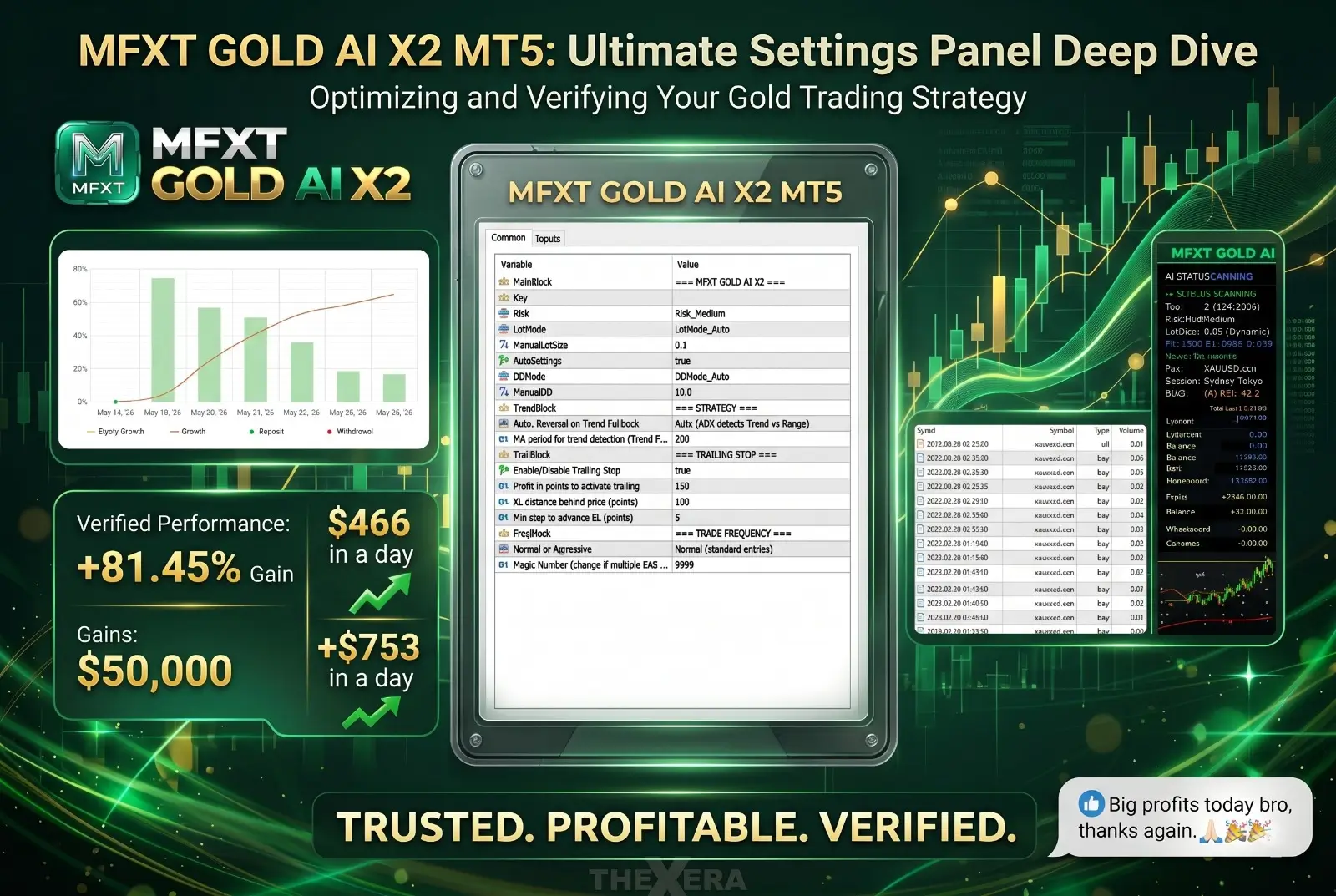
Automated trading systems often look attractive from screenshots or backtest summaries, but experienced traders usually focus on the settings structure first. The configuration panel often reveals how the EA handles risk, how aggressively it trades, and what type of market conditions it prefers. That matters more than marketing claims because live market behavior depends heavily on execution logic and exposure control.
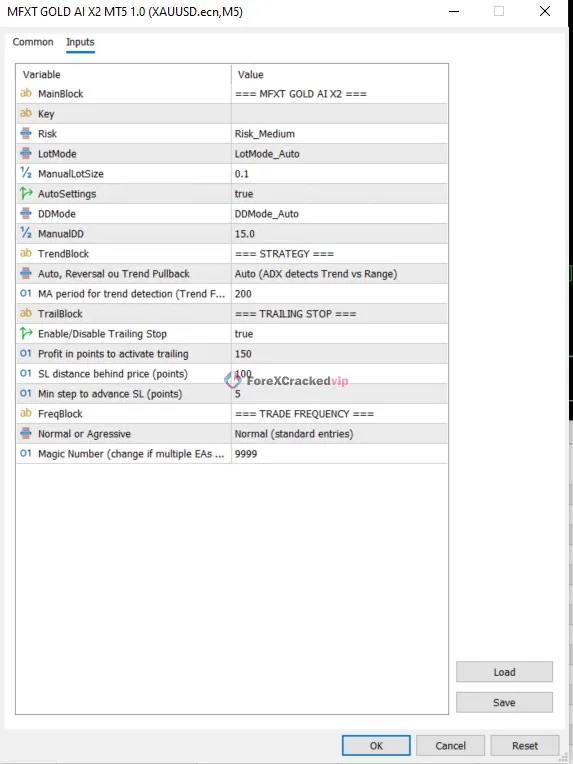
Based on the visible configuration, MFXT GOLD AI X2 MT5 appears to combine trend detection with adaptive execution logic. The use of ADX-based market condition filtering, trailing stop functionality, and automated drawdown management suggests that the EA is structured to adjust behavior depending on whether gold is trending or ranging.
This MFXT GOLD AI X2 MT5 settings review explains how the setup behaves, what the settings reveal about the strategy structure, and what traders should understand before using it in live market conditions.
➡️ MFXT GOLD AI X2 MT5 Download: Available on Unlimited Download
➡️ Telegram Support: Join for updates, announcements, and support
MFXT GOLD AI X2 MT5 settings panel Overview
The setting panel includes several layers of trading control rather than a single-entry setup structure. The EA contains strategy mode selection, trend filtering logic, trailing stop management, drawdown controls, and trade frequency management.
There are also automated risk settings and lot sizing controls, which suggests the EA attempts to adapt exposure dynamically instead of relying on fixed manual sizing alone. The configuration also indicates that stable VPS execution and low-latency broker conditions are important for consistent order handling.
Core Strategy Settings
The core structure of this MFXT GOLD AI X2 MT5 settings appears centered around adaptive market classification. Instead of forcing one trading model permanently, the system uses ADX-based filtering to determine whether the market is trending or ranging before selecting execution behavior.
The 200-period moving average strongly suggests higher timeframe directional filtering. In gold trading systems, a long MA filter is commonly used to avoid trading against dominant market momentum. This often reduces unnecessary countertrend entries during strong directional moves.
The automatic strategy switching structure indicates the EA is designed to reduce manual intervention. That makes it easier for beginners, but it also means traders must trust the EA’s internal market classification logic. If the ADX detection reacts slowly during sudden volatility shifts, the system may temporarily misclassify market conditions.
In strong trends, this structure usually performs better because trailing and directional filtering align with momentum continuation. Gold markets often produce extended moves during major news cycles, and a 200 MA filter helps reduce entries against those moves.
During ranging conditions, adaptive systems attempt to switch toward reversal or pullback logic. That improves flexibility, but ranging gold markets often produce false breakouts. If volatility spikes suddenly, the EA may experience short-term whipsaw behavior.
This type of setup generally performs more consistently during medium-to-high directional volatility rather than extremely flat sessions.
Risk Management & Lot Size Settings
MFXT GOLD AI X2 MT5 settings appears structured around semi-controlled risk automation. Auto lot sizing suggests that position exposure scales according to account conditions rather than remaining fixed permanently.
The medium-risk profile indicates the EA is not configured for ultra-conservative execution, but it also does not appear excessively aggressive based on the visible settings. The 15% drawdown reference suggests the system contains internal equity protection or adaptive exposure reduction logic.
Automatic drawdown handling is important for gold EAs because XAUUSD volatility changes rapidly during major economic releases. Systems without exposure control often struggle during unexpected price expansion.
Auto lot sizing performs well when account balance and leverage conditions remain stable. However, during rapid drawdown periods, dynamic sizing sometimes increases exposure faster than expected if recovery logic activates aggressively.
Gold trading systems are particularly sensitive to volatility spikes because spreads widen during high-impact sessions. Even moderate-risk settings may experience temporary equity pressure during fast-moving markets.
This configuration suggests the EA aims for balanced exposure rather than high-frequency aggressive compounding. Traders still need sufficient account margin because gold volatility can create sharp floating drawdowns before recovery occurs.
Indicator Settings
The indicator structure is relatively simple, which is usually positive for execution stability. Systems overloaded with indicators often produce delayed entries. Here, the EA seems focused on directional confirmation and market strength filtering rather than excessive technical layering.
The 200 MA acts as a long-term trend filter, while ADX likely measures directional strength and volatility expansion. Together, these filters help the EA avoid trading randomly during unstable conditions.
This structure suggests the system is attempting to prioritize trade quality over raw trade quantity.
Long-term MA filtering works well during sustained gold momentum. It reduces countertrend entries and often improves holding stability for trailing stop systems.
ADX filtering is useful because gold markets alternate between explosive momentum and consolidation phases. During quiet periods, ADX values usually decline, reducing unnecessary trades.
One limitation is that lagging indicators react after momentum begins. During sudden reversals caused by economic news, the EA may enter late or experience delayed exits.
This type of structure generally behaves better on higher timeframes where market noise is reduced.
Take Profit & Trailing Stop Settings
The trailing stop configuration reveals that the EA prefers holding trades once momentum develops instead of taking extremely fast exits. A 150-point activation threshold suggests the system waits for meaningful movement before protecting profits.
The 100-point trailing distance indicates the EA allows room for gold price fluctuation rather than using tight stop movement. Gold markets often retrace aggressively during trends, so wider trailing structures help prevent premature exits.
The small step advancement value suggests the stop updates progressively once activation conditions are met.
Trailing systems usually perform well during sustained directional markets because profits continue expanding while risk gradually decreases. This fits gold trading behavior during major trend phases.
During choppy conditions, trailing stops often activate and close repeatedly with smaller profits. If spreads widen significantly, execution precision becomes important because gold price fluctuations are fast.
A wider trailing distance improves trade survival but also increases floating drawdown exposure before exits occur. Traders should understand that trailing logic improves trend capture, but it does not eliminate reversal risk.
Trade Frequency Settings
The EA is configured for standard execution frequency rather than aggressive position stacking. That usually reduces exposure spikes and lowers trade overlap risk.
A normal entry profile often means the EA waits for stronger confirmation before opening trades. This is important for gold systems because excessive entries during volatility expansion can create unstable equity swings.
The separate magic number allows the EA to run alongside other systems without trade management conflicts.
Normal-frequency systems often experience smoother equity curves than aggressive scalping models. They trade less often but generally aim for higher-quality entries.
During high-volatility gold sessions, lower-frequency trading reduces spread exposure and execution slippage. However, fewer trades also mean slower recovery periods after losing streaks.
This setup appears more suitable for traders seeking controlled automation instead of extremely aggressive account growth strategies.
VPS & Execution Settings
MFXT GOLD AI X2 MT5 settings relies on continuous execution monitoring because trailing logic and adaptive behavior require uninterrupted platform connection. That makes VPS stability important.
Gold EAs often react quickly during volatility spikes. Delayed execution or unstable MT5 connectivity can affect trailing stop movement and order precision.
- AutoSettings + true
- Trailing Stop + enabled
- Adaptive execution structure + visible through automated logic
Low-latency VPS hosting improves consistency, especially during major market sessions such as US open hours. Slippage becomes more visible when gold volatility expands rapidly.
Execution-sensitive EAs tend to behave differently between brokers. Fast ECN execution with lower spread conditions generally improves trade handling compared to high-spread market maker environments.
Recommended Timeframe & Currency Pair Settings
The structure strongly suggests this EA was designed primarily for XAUUSD rather than diversified multi-pair trading. Gold volatility aligns well with adaptive trend-detection systems and trailing stop behavior.
The long MA filter indicates the EA likely performs better on higher timeframes where noise reduction improves trend clarity.
Gold systems using trend filtering usually behave more consistently on M15, M30, or H1 charts compared to ultra-low timeframes.
Lower timeframes increase spread sensitivity and false signal frequency. Higher timeframes reduce trade frequency but improve directional quality.
Crypto markets may produce unstable behavior because volatility structure differs significantly from gold price movement.
Drawdown Risk Analysis
MFXT GOLD AI X2 MT5 settings appears designed around moderate automated risk exposure rather than aggressive martingale escalation. The visible settings do not show clear evidence of high-risk grid multiplication, which is a positive sign from a capital preservation perspective.
Still, gold volatility creates natural drawdown pressure even for balanced systems. Losing streaks remain possible during unstable market transitions where trends reverse repeatedly.
The adaptive logic may reduce unnecessary entries during ranging conditions, but no EA completely avoids drawdown during abnormal volatility. Traders should expect periods where floating losses remain open before recovery occurs.
Using insufficient account balance or excessive leverage increases liquidation risk significantly during gold spikes.
VPS & Execution Requirements
A stable MT5 VPS setup is important for this EA because trailing stop movement and adaptive strategy switching require uninterrupted execution.
Low latency helps reduce delayed stop updates during rapid gold price movement. VPS hosting near the broker server usually improves consistency.
Broker execution quality also matters because gold spreads widen during major news events. Poor execution environments increase slippage risk and affect trailing stop accuracy.
Recommended Broker Conditions
MFXT GOLD AI X2 MT5 settings appears more suitable for ECN or STP broker environments with stable execution quality.
Recommended conditions include:
- Low gold spreads
- Fast MT5 execution
- Stable liquidity during US sessions
- Minimum execution delay
- Moderate-to-high leverage with proper risk control
Excessive slippage or unstable spread conditions may reduce trailing efficiency and increase drawdown pressure.
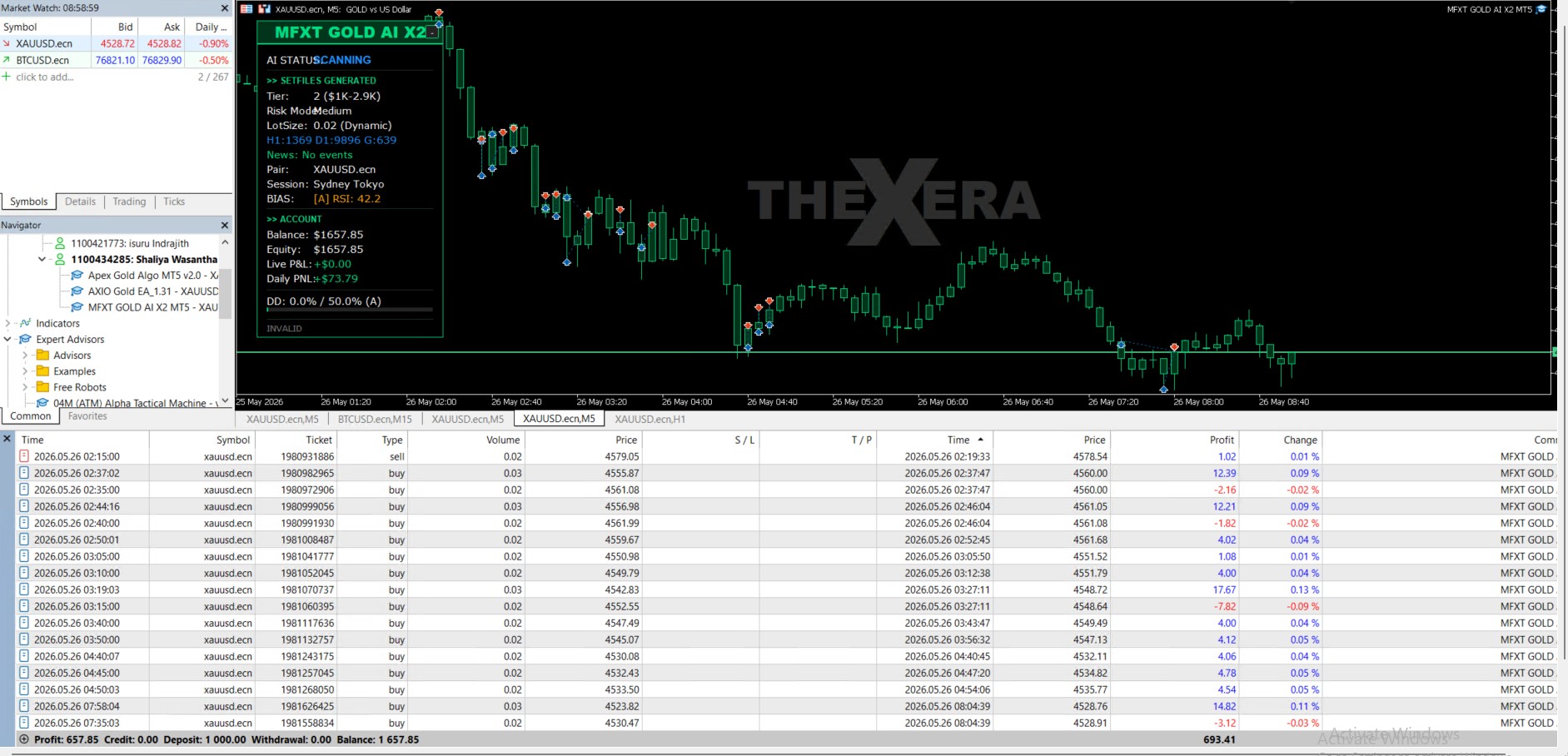
Practical Summary
This MFXT GOLD AI X2 MT5 settings review shows an EA structure focused on adaptive market detection, controlled execution frequency, and trend-following trade management.
The system appears designed for traders who prefer semi-automated exposure control rather than highly aggressive recovery trading. The trailing logic and 200 MA filtering suggest the EA performs better during directional gold movement than during unstable consolidation phases.
Risk remains present because gold volatility changes rapidly during economic events. Traders should treat the EA as a structured trading tool rather than a guaranteed profit system.
For long-term use, stable VPS hosting, disciplined leverage selection, and realistic drawdown expectations remain important.
FAQ
Is MFXT GOLD AI X2 MT5 designed mainly for gold trading?
Yes. Based on the settings structure and volatility handling logic, the EA appears optimized primarily for XAUUSD market behavior.
What timeframe works best for this EA?
The structure suggests medium-to-higher timeframes such as M15, M30, or H1 are more suitable than ultra-low scalping charts.
Does this EA use grid or martingale logic?
The visible settings do not clearly show aggressive martingale escalation. The EA appears more focused on adaptive execution and trailing management.
Is VPS hosting necessary?
Yes. VPS hosting improves execution stability, especially for trailing stop updates and gold volatility handling.
Is this EA beginner friendly?
The automated settings help simplify configuration, but beginners still need basic understanding of leverage, drawdown, and broker conditions.
What leverage is suitable?
Moderate leverage is generally safer for gold EAs. Excessive leverage increases liquidation risk during high-volatility sessions.
What account size is recommended?
Larger account balances usually handle floating drawdowns more safely. Small accounts face higher exposure pressure during volatility spikes.
Does the EA work on crypto pairs?
The setup appears more aligned with gold market structure than crypto volatility conditions.